Nashville is a genuinely good city for children, but not for the reason most visitors assume. It is good because the family attractions cluster tightly — downtown, Midtown, Opry Mills and the Percy Priest Lake area each hold several hours’ worth of things to do within a short drive of one another. That means you can build a realistic day around one district rather than criss-crossing the city, which matters enormously when you have a toddler in a pushchair or a child who has reached their limit by early afternoon.
What follows is a parent-first ranking, not a popularity list. The strongest family attractions come first. Each entry explains which ages it genuinely suits, what the stroller situation actually is, where the practical friction shows up (heat, walking, height restrictions, queueing, sensory load), and when a different option would serve your family better. Operational details are given as planning guidance — Nashville’s attractions change prices, hours and programmes regularly, so always confirm current information before you commit a day to anything.
1. Nashville Zoo at Grassmere
The zoo is the strongest full-day family attraction in Nashville, and it earns that position on range rather than spectacle. It sits on a large, mostly wooded site south of downtown with wide paved paths, which matters more than it sounds: a pushchair is genuinely usable here rather than merely tolerated, and the distances are manageable for children who are walking. Habitats include Sumatran tigers, Andean bears, red pandas, kangaroos and flamingos, plus a farm area and historic home incorporated into the grounds that often interests toddlers more than the larger animal exhibits.
Budget a full morning or a full day. A complete loop with children is realistically three to four hours, and longer if you use the playground or the carousel. The zoo’s main family strength is that it works across a wide age band at once — a four-year-old will spend most of their time at the farm and the interactive play areas, while an eight- or ten-year-old will engage with the larger habitats. That means siblings of different ages can usually be kept occupied on the same route, which is not true of every attraction on this list.
The main practical risks are heat and timing. Nashville summers are humid, and while the zoo has shaded sections, the route is not consistently covered. Arriving at opening gets you cooler temperatures, more active animals and smaller crowds. If you have a napping toddler, a morning visit that finishes before lunch is far more realistic than trying to push through the entire park. Food is available on-site at standard theme-park prices; many families bring a packed lunch and eat at the picnic areas, which is both cheaper and more flexible with young children.
For older pre-teens who have outgrown animal parks, the zoo will hold less interest than the science centre. For families with children roughly aged two to twelve, it is the safest single bet in the city.
2. Adventure Science Center
This is the best indoor family attraction in Nashville and the obvious alternative when heat, rain or a tired child rules out an outdoor day. It sits near Fort Negley in a multi-level building with well over a hundred hands-on exhibits spanning sound, the human body, space and natural history. The planetarium runs scheduled shows in a large dome, and there is a makerspace with tools and equipment aimed at older children under supervision. For pre-schoolers, the centre runs a weekly STEM storytime that is included with general admission — worth timing a visit around if you have a three- or four-year-old.
The reason this works well for families is the wide developmental range it covers without one age group dominating. Toddlers have dedicated early-years areas. School-age children can move between interactive stations at their own pace. Pre-teens who would find a younger children’s museum too babyish will engage with the planetarium and makerspace. The building is fully accessible, with lifts between floors and space for pushchairs throughout.
Two caveats. First, the most popular exhibits — particularly the sound and music stations — become loud and crowded during school holidays and weekend afternoons, which is difficult for children sensitive to sensory overload. Second, food on-site is limited; the surrounding area is not rich in family restaurants, and many families pair a visit with lunch at the Nashville Farmers’ Market a short drive away. The centre also closes on certain weekdays, so check the current schedule rather than assuming a seven-day operation. Allow three hours for the main exhibits, closer to four with a planetarium show.
3. Tennessee State Museum
This is the best free family attraction in Nashville, and it is free in the fullest sense — no admission charge for anyone, with free on-site parking. That combination is unusual and genuinely useful for families who want a substantial activity without committing to a significant spend. The museum covers Tennessee history from pre-colonial times through the civil rights era, and the dedicated children’s gallery, aimed at roughly ages three to eight, uses play-based exhibits built around state symbols. The gallery closes before the rest of the museum, so if you have small children, visit it first.
The layout is spacious and pushchair-friendly throughout, with family bathrooms including changing tables on the ground floor. For older children, the main galleries cover the Civil War, the Tennessee Centennial Exposition and the state’s musical heritage; the content is text-heavy in places, which limits engagement for very young children but works well for confident readers. The museum is rarely crowded, which is a real advantage for children who find busy environments difficult.
The location beside Bicentennial Capitol Mall State Park is the other practical reason to come. You can pair an indoor museum visit with outdoor time at the park’s splash pad and lawns, which breaks up a day for restless children. For budget-conscious families, or for a second or third day in the city when you have already paid for the bigger attractions, this is the single strongest default in Nashville.
4. Centennial Park and The Parthenon
Centennial Park is Nashville’s central green space and the most practical free family stop in the city. It has wide lawns, walking paths, a duck pond, a well-equipped playground with separate areas for younger and older children, and the full-scale replica of the Athenian Parthenon at its centre. The park itself is free, the parking is free in designated areas, and the playground is a reliable way to burn off energy between paid attractions. The park also hosts free children’s events on many Saturdays, typically with craft activities and performances.
The Parthenon houses a museum with a large statue of Athena and a compact gallery of paintings and artefacts. Admission is modest — a few dollars per person, with very young children free. Whether it is worth entering depends heavily on age: children who have encountered Greek myths at school often find the Athena statue genuinely impressive, and the museum is small enough to hold attention for thirty to forty-five minutes. Younger children will usually be more interested in the park outside, which is fine — for most families the park is the main event and the Parthenon is optional.
Because it is central, free and low-pressure, this is a good insertion point into almost any Nashville family itinerary. It pairs naturally with the Frist Art Museum and the downtown core.
5. Nashville Children’s Theatre
This is one of the oldest continuously operating children’s theatres in the United States, and it is purpose-built for young audiences in a way that most theatres are not. Main-stage productions are performed by professional adult actors and are designed for children roughly aged four to twelve. A separate series for children aged five and under uses shorter, more interactive formats suited to very young attention spans. Productions typically run around an hour, which is a realistic duration for children who have never sat through live theatre.
For families introducing a child to live performance, this is a much lower-pressure environment than a standard venue. Audiences are full of children, the atmosphere is relaxed, and the seating is designed so that children can see the stage without being lifted. For children who might struggle with conventional theatre etiquette, the environment is forgiving rather than formal.
Booking ahead is important. Popular productions sell out, especially during school holidays and at weekends. A performance is a strong half-day activity and pairs well with a morning at the Adventure Science Center or the zoo, both a short drive away.
6. Frist Art Museum
The Frist is the rare art museum that actively welcomes children rather than merely permitting them. Its ArtQuest gallery is an interactive art-making space where children and adults work with printmaking, watercolours and other media alongside art educators. Children under a certain age must be accompanied by an adult, which keeps the space manageable. Admission is free for children and teenagers, which makes the Frist one of the most affordable cultural attractions in Nashville for families, and the building — a converted Art Deco post office — is pushchair-accessible throughout with lifts and wide corridors.
The practical approach with children is to treat ArtQuest as the primary destination and the galleries as an optional extension. Exhibition content changes regularly, and the appeal of any given gallery depends heavily on your child’s age and interests; a photography exhibition may hold a ten-year-old for twenty minutes and a four-year-old for two. ArtQuest is the reliable draw. The on-site café is useful for a mid-visit break.
The Frist pairs well with a visit to the Farmers’ Market or the Tennessee State Museum, both within a short drive. The main limitation is that ArtQuest can become busy during school holidays, and the gallery content is worth checking in advance if the wider museum is part of your plan.
7. Cumberland Park
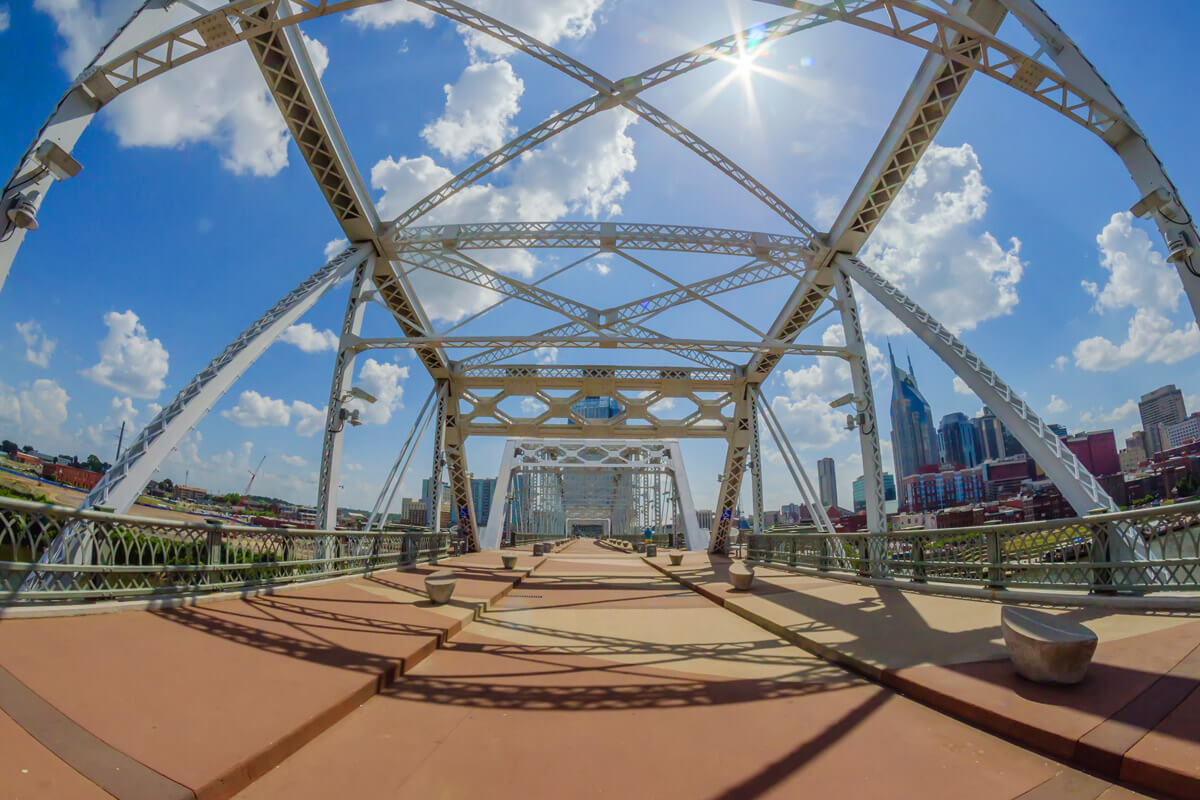
Cumberland Park is a purpose-designed children’s play space on the east bank of the Cumberland River, and it is the best free playground in central Nashville. It includes a sandpit, a maze, tandem seesaws, a splash pad, a climbing wall and an outdoor amphitheatre. The equipment is designed for a range of ages, with separate areas for younger and older children. Because it sits at the foot of the pedestrian bridge, it combines naturally with a riverfront walk.
The splash pad is a significant asset in summer — a free way for children to cool down without the cost and logistics of a full waterpark. The terrain is flat and pushchair-friendly, and the park is well maintained. The main limitation is exposure: shade is limited, so mid-day visits in summer are uncomfortable. Early morning or late afternoon works much better. For children aged roughly two to ten who need a free, active outdoor stop, this is one of the best options in the city.
8. Bicentennial Capitol Mall State Park and Nashville Farmers’ Market
These two sit side by side and function best as a single stop. The park is a nineteen-acre urban green space beside the State Capitol with a large granite map of Tennessee, a carillon, memorials and a splash pad that operates in summer. It is flat, paved and pushchair-friendly, with wide lawns suitable for picnicking and running. There is no dedicated playground equipment, so children who need structured play will be better served by Cumberland Park or Dragon Park — but as a free, central, low-effort outdoor stop it does its job well.
The Farmers’ Market next door is the more useful half of the pairing for families. It is a year-round working market with a food hall containing a wide range of vendors, which is genuinely helpful when travelling with children who have different preferences or dietary requirements. Admission is free and the space is accessible. The market also runs seasonal family events with activities aimed at children. As a lunch stop between the State Museum and the Capitol, it is one of the most practical family options downtown. As a standalone destination it is less compelling; children who are not hungry will find it less engaging than a playground.
9. Shelby Bottoms Nature Center and Greenway
Shelby Bottoms is East Nashville’s quiet outdoor option — an environmental education centre with a children’s nature play area, a greenway with several miles of paved and accessible trails, and a programme of free family events including guided walks and nature-themed activities. The paved trails suit pushchairs and young walkers; the rougher trails are better for older children. The nature centre has exhibits on local wildlife and runs scheduled family programmes, so if a structured activity is part of your plan, check the calendar before you go.
This is a good choice for families who want outdoor time without crowds, and it works particularly well for children who find the noise and scale of larger attractions overwhelming. The main limitation is that it is a lower-key experience than the zoo or the waterpark — it is a place to walk, explore and slow down rather than a place with big set-piece attractions. For a free, low-key morning or afternoon, it is strong.
10. Nashville Public Library – Main Library Puppet Shows
The main library downtown runs free puppet shows on weekend mornings, produced by the library’s own puppet troupe using a large collection of handmade puppets. The performances are short — under half an hour — which is an ideal duration for young children and means the activity can be combined with other nearby stops. The library’s children’s section is well stocked and welcoming, so a visit can extend naturally beyond the show itself.
For children roughly aged two to eight, this is one of the best free activities in the city. Because the shows run on a limited schedule and can fill up, arriving early is advisable. The location on Church Street places it within walking distance of the Frist and the Country Music Hall of Fame, so it slots easily into a downtown day. The main constraint is that it is a seated, quiet activity — children who need to move will do better with the parks or the science centre.
11. Fannie Mae Dees Park (Dragon Park)
Dragon Park is a Midtown neighbourhood park built around a large mosaic dragon sculpture that children can climb on — the kind of feature that makes a park memorable rather than interchangeable. The playground has separate areas for toddlers and older children, and the park includes one of Tennessee’s earliest fully accessible playscapes, with ramps and a wheelchair-accessible swing. The equipment was renovated relatively recently and includes a good number of slides.
This is a solid free option if you are in the Midtown or Vanderbilt area for another reason, and it works for children roughly aged two to ten. It is less of a destination than Centennial Park or Cumberland Park, but it does the same job — a free, active stop that lets children burn energy between paid attractions. Allow forty-five minutes to an hour and a half.
12. Nashville Sounds at First Horizon Park
A Nashville Sounds baseball game is one of the most affordable family experiences in the city, and the games are explicitly set up with children in mind. The Sounds are the Triple-A affiliate of the Milwaukee Brewers, playing in a compact ballpark in the Germantown area. Sunday home games typically include family promotions with pre-game autograph sessions and a post-game opportunity for children to run the bases. Tickets are inexpensive, and the atmosphere is relaxed enough that children can move around without the formality of a major-league venue.
The ballpark also includes activities beyond the game itself — mini-golf, basketball shootout, table tennis and cornhole — which matters a great deal for children who lose interest in the baseball after an inning or two. For a first live sports experience, this is a much better introduction than a major-league stadium: shorter games, smaller crowds, lower prices and a more forgiving environment. Food is standard ballpark fare at lower prices than major-league parks.
Evening games are cooler and often more comfortable with younger children, but they finish later. Day games in mid-summer can be hot, so shade and sun protection matter. For children roughly aged four to twelve, a Sounds game is a strong low-cost afternoon or evening and pairs well with a morning in the same area.
13. Cheekwood Estate & Gardens
Cheekwood is a large botanical garden and historic estate in the Belle Meade area, and it works for families because it has invested in children’s programming rather than simply allowing children to visit. The grounds include a storybook trail, a sculpture trail, a miniature train garden and seasonal installations — including a holiday lights display and a spring tulip festival — designed to appeal across age groups.
The practical challenge is terrain and exposure. The gardens cover a large area with slopes and some uneven paths, and much of the route is outdoors with limited shade. A pushchair can handle the main paths, but some of the more interesting sections involve steps or gravel that are harder work. Families with toddlers still in a pushchair should plan around the accessible routes; families with older children who walk independently will find the estate an easy half-day out, particularly in spring and autumn when temperatures are moderate.
Admission is relatively high for a garden visit, and the cost is more justifiable if you visit during a special event or seasonal display when the gardens offer something beyond the standard planting. For a family on a tight budget, the free parks and the State Museum offer better value. For a slower outdoor day with space for children to run — provided the weather cooperates — Cheekwood is a good choice.
14. Pfunky Griddle
This is a restaurant rather than an attraction, but it earns its place because it solves a specific family problem: how to make a meal genuinely engaging for children rather than merely tolerated. Each table has its own griddle, and guests cook their own pancakes, French toast and other breakfast items, choosing from a range of toppings. For children, the appeal is immediate — they are cooking their own food, which turns breakfast into an activity rather than a wait.
The menu includes gluten-free and vegan batter options, which is useful for families with dietary requirements. The restaurant is in Berry Hill, south of downtown, which makes it convenient if you are visiting the zoo or the science centre. The main limitation is that griddle cooking requires parental supervision, particularly with younger children, so it is not a hands-off experience for adults. For children roughly aged three to twelve, it makes a memorable start to a day of attractions.
15. Nashville Shores Waterpark
Nashville Shores is the largest waterpark in the Middle Tennessee area, on Percy Priest Lake east of the city. It has a wave pool, a range of water slides, a lazy river and a dedicated children’s splash and play structure. For families with children who are comfortable in water, it is a full-day destination that also has lake beach access on the same site.
The most important thing to understand before you go is the height restrictions. Waterparks typically apply minimum heights to the larger slides and to any floating inflatable course, and those thresholds determine what your child can actually do. A six-year-old who is tall enough for the mid-tier slides may still be excluded from the largest ones, which means a family with children of different heights will need to split supervision. Before committing to a day here, check the current height requirements on the park’s own website and measure your children — this is the single most common source of disappointment at waterparks.
Younger children and non-swimmers are catered for at the splash structure and the lazy river, but the park is not a quiet environment. It is crowded during summer weekends and school holidays, and the noise and splash levels can be overwhelming for children with sensory sensitivities. Food is available on-site and outside food is restricted. Parking is an additional cost. For children roughly aged five to twelve who enjoy water, it justifies the cost of a full day; for families with toddlers or children who prefer non-water activities, the zoo or science centre will use your time and money better.
16. The Adventure Park at Nashville Shores
This is a treetop ropes course and zipline park on the same site as Nashville Shores, and it is a genuinely different experience from the waterpark. It has a network of treetop trails graded by difficulty, with obstacles including suspension bridges, cargo nets, rope swings and ziplines. A smaller adventure playground is available for younger children, which means families with mixed ages can visit together without one group waiting passively for the other.
Two things determine whether your child can participate. First, the minimum age for the treetop trails, which is typically around seven. Second, reach requirements — the park sets a minimum reach span for different age brackets, and children who cannot reach the safety lines cannot climb. Children under a certain age must be accompanied by an adult. Confirm both before booking, because they rule out the experience entirely for some families rather than simply limiting it.
A full session includes roughly two hours of climbing plus orientation and harnessing, so budget a half-day. The park is outdoors and weather-dependent, and children who are nervous about heights may find the higher trails intimidating rather than fun. For children who enjoy physical challenge, this is one of the best active experiences in the Nashville area and adds something the zoo and science centre cannot.
17. Madame Tussauds Nashville
This is a music-themed wax museum at Opry Mills with figures of musicians across several genres. The experience is interactive rather than purely observational — visitors pose with the figures, sing along in staged environments and take photographs in settings designed for sharing. For children who recognise the artists, the appeal is immediate; for younger children who do not, the scale and realism of the figures can still be engaging. Pushchairs are permitted throughout, and parking at Opry Mills is free.
The attraction takes roughly an hour at a comfortable pace, which makes it a useful shorter activity to combine with other Opry Mills attractions. The adjacent mall has a food court and a cinema, so it can be part of a longer indoor day if the weather is poor. The main limitation is that the experience is essentially a series of photo opportunities; children who are not interested in the celebrities will lose interest quickly. For children roughly aged six to twelve who enjoy music and posing for photographs, it is a fun, low-stress hour. For toddlers or children who prefer active experiences, it is a poor use of time.
18. Gaylord Opryland Resort – Delta Riverboats and Atrium
The Gaylord Opryland is a hotel, but its indoor atrium gardens are free to walk through and genuinely worth an hour if you are already in the Opry Mills area. The Delta Riverboats run short indoor cruises through the atrium, with guides pointing out plants and fish. The cruises are calm and visually engaging, which suits children who need a low-intensity break from more active attractions, and they are inexpensive. There are also seasonal self-guided activities such as scavenger hunts that take families through the resort’s landmarks.
The resort also operates an indoor and outdoor water attraction, but access is tied to room packages rather than sold as a standalone day ticket, so it is only relevant if you are staying at the resort. For families staying there, it is a significant amenity and effectively a full-day activity. For families not staying there, the atrium walk and the riverboat cruise are the realistic options and are worth an hour if you are nearby. The resort is fully accessible.
19. Lane Motor Museum
This is a specialised collection of European cars and motorcycles, and it is a niche attraction rather than a broad family one. That said, it works well for families with children who are interested in cars, and it includes an indoor play area with automotive-themed toys and driving games that can occupy younger siblings while adults explore. The museum is a working collection rather than a polished visitor attraction, which gives it an informal atmosphere that suits families better than a formal museum might.
Admission is modest, and the location south of downtown is convenient if you are visiting the zoo or the science centre. The variety of vehicles — including unusual prototypes and microcars — can be genuinely engaging for children who like machines. For families without that specific interest, the other attractions on this list offer broader appeal. Allow an hour to ninety minutes.
20. Tennessee Central Railway Museum
This is a small, volunteer-run railway museum in East Nashville with a collection of vintage cars and locomotives, and — more importantly for families — excursion trains on selected weekends. The train rides, typically two to three hours on a restored passenger train, are the main draw. For children who are interested in trains, combining static exhibits with an actual ride is far more engaging than a purely static museum.
The critical planning detail is the schedule. The excursion trains run on specific weekends rather than daily, and the museum’s opening hours are limited, so check the calendar before planning a visit around it. Pushchairs are permitted on board. The museum is not a large attraction, and a visit combined with a train ride is a half-day. For children roughly aged three to ten with a train interest, it is worthwhile; for families without that interest, the other attractions offer more consistent value.
21. Belle Meade Historic Site
Belle Meade is a former plantation and mansion in the Belle Meade area, with guided tours of the house, outbuildings and grounds. It is primarily an adult-oriented historic site, and the standard mansion tour is not designed for young children. However, the site runs family-oriented programmes on selected dates, including guided tours for children roughly aged four to twelve that incorporate hands-on crafts and activities in a dedicated space.
If you are considering Belle Meade with children, the family programmes are the reason to go, and checking the calendar for those specific dates is essential. The grounds are pleasant for walking, and the site is close to Cheekwood, so the two can be combined. For families with children who enjoy history and can participate in a guided programme, it is worthwhile. For younger children or children who prefer active experiences, the other attractions on this list are better choices.
22. Grand Ole Opry
The Grand Ole Opry is a Nashville institution, and it can work for families with older children who have an interest in music or live performance, but it is not a children’s attraction and should not be treated as one. Shows run several nights a week, typically featuring a rotating lineup of country, bluegrass and Americana artists. The format — multiple short performances rather than a single headliner — can hold attention better than a standard concert for children new to live music. Backstage tours during the day give a behind-the-scenes view of the venue.
Two practical considerations matter. Evening shows run late, which will not suit younger children, and tickets can be expensive for a family. The Opry is at Opry Mills, so it combines naturally with Madame Tussauds and the Gaylord Opryland atrium. For children aged eight and over who enjoy music, a show is memorable. For younger children, the daytime backstage tour or the other Opry Mills attractions are a better fit.
23. Nashville Farmers’ Market Seasonal Festivals
The Farmers’ Market runs seasonal family festivals through the year — strawberry festivals, watermelon festivals and similar events — with pony rides, petting zoos and activity zones for children. These are free to attend and add a festive element to what is otherwise a food market. If your visit coincides with one, it turns the market from a meal stop into a genuine family activity.
The limitation is timing: these are event-dependent and not available year-round, so they cannot be the basis of a planned trip unless you have checked the calendar. When they are running, they are one of the better free family options downtown and combine easily with the Bicentennial Mall and the State Museum.
24. Wave Country
Wave Country is a smaller, seasonal outdoor waterpark in the Donelson area, and it functions as a lower-cost, lower-intensity alternative to Nashville Shores. It has a wave pool, several slides and a children’s area, and the scale is more manageable for families with younger children who would find a large waterpark overwhelming. It is seasonal and only open in summer.
The height restrictions are less extensive than at Nashville Shores, which makes it a better fit for families with children who are too short for the larger park’s biggest slides. As with any waterpark, confirm current height requirements before you go. Parking is typically free or inexpensive, which reduces the overall cost. For families with children roughly aged four to ten who want a water day without the full-day commitment and cost of a large park, Wave Country is worth considering.
25. Percy and Edwin Warner Parks
The Warner Parks are a large network of wooded parkland in the Belle Meade area, and they are the best option on this list for families who want genuine nature rather than a landscaped attraction. The parks have miles of walking and hiking trails, picnic areas, an equestrian centre, a nature centre with naturalist programmes, and — in the Edwin Warner section — a nature play area. Terrain varies from flat and paved to steep and unpaved, so families with pushchairs should stick to the lower trails.
This is a free, uncrowded option that works particularly well for children who need space to move without the stimulation of a busy attraction. The nature centre runs programmes for families, and the parks host occasional free events. The main limitation is that there are no big set-piece attractions — it is a walking and exploring destination, and children who need structured entertainment will be better served elsewhere. For a quiet half-day outdoors, it is one of the best things to do with children in Nashville.
Planning the Day Around These Attractions
The single most useful planning decision in Nashville is to cluster your stops geographically rather than by ranking. Several natural pairings work well:
The downtown cluster — Tennessee State Museum, Bicentennial Mall, Farmers’ Market, Frist Art Museum, library puppet shows and Cumberland Park — sits within walking or short-driving distance of one another and can fill a full day without moving the car. The Midtown cluster — Centennial Park, the Parthenon and Dragon Park — combines free outdoor time with a low-cost indoor stop. The Opry Mills cluster — Madame Tussauds, Gaylord Opryland, the Grand Ole Opry and the mall — works as an indoor day when the weather is poor. And the south Nashville cluster — the zoo, Adventure Science Center, Lane Motor Museum and Pfunky Griddle — can be combined into a full day if you start early.
Balance active and low-energy stops across a day. A morning at the zoo or a waterpark will exhaust younger children by early afternoon; pairing it with something seated, like the puppet show or a riverboat cruise, works much better than stacking two high-energy attractions back to back. Conversely, if you have booked a seated activity, follow it with a park or playground so children can move.
Finally, plan around the heat. Nashville summers make mid-day outdoor attractions difficult for young children, and the difference between a morning visit and a mid-afternoon visit to an exposed site can be the difference between a good day and a miserable one. Indoor attractions, shaded parks and water-based activities are the sensible choices between roughly eleven and three in summer. Everything on this list can be scheduled around that constraint with a little planning.